 SpanDraft

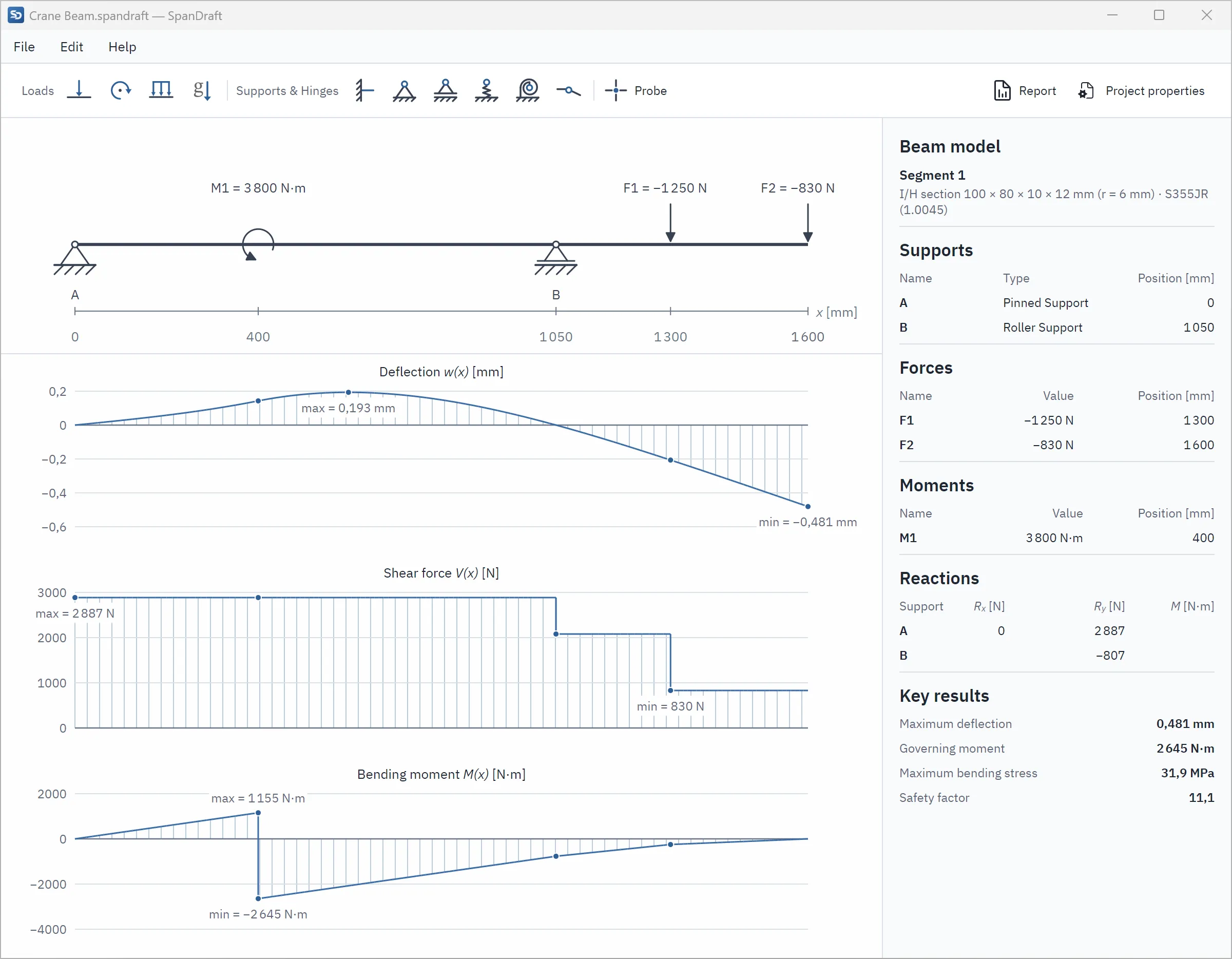
How the analysis works
SpanDraft uses the linear-elastic Euler–Bernoulli beam model. The analysis accounts for loads, supports, material properties and cross-section together to determine deflection, internal forces and moments, and support reactions.
The technical documentation describes the model, its assumptions and limitations.
Solver verification comprises 13 472 successful individual comparisons across 18 acceptance cases, including comparisons with analytical solutions and two independent programs as well as physical and metamorphic checks. Scope, acceptance status and limits are described in Solver verification.
Deflection
The deflection along the beam depends on its loading, support conditions and flexural rigidity.
Bending moment
The bending moment describes the bending action along the beam.
Shear force
The shear force describes how the bending moment changes along the beam. Point loads and support reactions can cause jumps in the shear force.
Support reactions
Solving the system yields the reaction forces and moments at the supports.
What SpanDraft includes
Straight beams with supports and loads. No 3D model, no FEA, no spreadsheet template.
- Supports, loads and internal hinges
- Place supports, loads and internal hinges along the beam. Statically indeterminate systems are supported.
- Cross-sections
- Cross-section editor and library for parametric and manual cross-sections.
- Materials
- Material data is stored with the project and is not affected by later changes to the library.
- PDF report
- Beam, cross-section, supports, loads, diagrams and key values.
- Limitations
- No code compliance checks.
Availability
SpanDraft runs on Windows and is open source. The source code is available on GitHub.
- Platform
- Windows
- Source code
- github.com/Stephan-Entw/SpanDraft
- Analysis
- Linear Euler–Bernoulli beam theory, no code compliance checks